
When Life Fell Apart: How Annie Stewart’s transition ‘pile-up’ led her to think differently about how to grow through a tough transition
In late 2019, Annie Stewart found herself in one of the toughest transitions of her life and it was — in her own words — “an experience that totally knocked me for a six”.
What made it especially confronting was that Annie had spent decades helping others navigate change. As an executive and career coach, coaching supervisor and author, she had supported hundreds of leaders and professionals through work and life transitions. She had written books about finding and following callings, and much of her work focused on helping people move toward meaningful next chapters in their lives.
But when several major aspects of her own life changed dramatically, Annie was suddenly on the other side of the conversation.
Within a short period, the life she knew no longer existed. “A relationship ended; one I had invested in deeply enough to give up my home and move in, believing we were building something lasting,” she says.
Around the same time, her former husband died unexpectedly. Although they had divorced years earlier, the grief was profound and complicated. “I loved him. We had shared a life, children and for many years, a business,” Annie says. “His death brought deep grief, not just for him and our children, but for everything that was unresolved between us.”
Then Annie broke her leg in a serious accident, and shortly after, COVID arrived.
Annie found herself rebuilding her life alone during lockdown while grieving, moving house, shifting her business online and trying to promote her second book. Her children were stepping into their own independent lives, her ageing parents needed support, and she was also adjusting to the quieter but significant physical and hormonal changes that come with midlife.
“I’m generally someone who is optimistic and used to managing complexity, but this time my stability was rocked off its axis,” she says. “All at once I was lonely, immobilised, no longer part of a couple, and an empty nester. I wondered whether I mattered to anyone.”
When Annie later reflected on that period, she realised something important: what she had gone through was not a single transition, but a pile-up of them.
Why tough transitions can change everything
Annie’s own transition pile-up became the catalyst for her latest body of research and book, When Everything Changes: Growing Through Life’s Tough Transitions, which explores the different types of transitions we face and what really happens when life shifts. It also examines how we can honour and move through these stages with greater understanding and self-compassion.
More than five years on, Annie now understands why tough transitions can feel so overwhelming. They rarely arrive alone. Instead, they overlap, intersect and intensify each other.
A relationship change might coincide with career or global uncertainty. Health shifts may happen alongside financial pressure or family responsibilities. Identity questions often surface at the same time as external changes.
“When several transitions happen together, you are not just adjusting to one change; you are adjusting to many layers of change at once,” she explains. “On top of that, you might also have someone close to you going through their own turbulent transition too.”
Some changes are so high-impact that Annie describes them as life-quakes. These are the big events that fundamentally reshape our whole landscape.
“While life-quakes can be very destabilising, they also reveal something deeper about the human experience of change,” she says. “Transitions are not simply about logistical adjustments, but also about psychological and emotional journeys.”
Difficult and hidden emotions
There are many emotions we experience during a tough transition, but one Annie believes is often hidden beneath the surface is shame.
“In many ways shame is one of the least talked about aspects of transitions,” Annie says.
Unlike grief, which is more openly recognised, shame tends to push people into silence.
Annie experienced this firsthand. While she intellectually understood the process of change, when her own life fell apart, it felt very different. “There can be a very private sense of failure,” she says. “I had spent years coaching people through their own changes, then suddenly my own life looked like a train wreck! There were days where I felt a paralysing sense of shame, as though I should have known how to handle it better.”
Over time she realised that acknowledging this emotional reality, rather than pretending everything was fine, was an essential step to seeking professional help and moving forward.
The shadow of unfinished transitions
Another important insight that emerged from Annie’s research is that some transitions remain unfinished. Life moves on, but emotionally sometimes things remain unresolved.
“In some cases, we think we’ve moved on, but part of us is still holding the experience, “she says.
This can happen after relationship endings, career setbacks, and losses or disappointments that were never fully acknowledged.
“These unfinished transitions often carry a shadow of longing,” she says. “A quiet sense that something important did not unfold the way we hoped. We might not talk about it often, but it can live inside us and show up as hesitation or fear about engaging fully with life again.”
Recognising this is an important step toward integration. “Rather than seeing these as personal failures, I encourage people to view them as part of the deeper human process of adapting to change.”
The life we imagined… and the life that happens
The hardest part of a tough transition might be the gap between the life we imagined and the life we find ourselves living.
“We carry a picture in our minds of how life was supposed to unfold,” Annie says. “When reality diverges from that picture, it can feel like cognitive dissonance, and the brain needs time to rewire itself.”
It might be a marriage or business we expected to last ends. A career path went a different way. Financial security suddenly changes. Addictive patterns make our life unmanageable. Our health or physical capacity shifts.
These kinds of situations can prompt deep internal questioning, when we start to reconsider what we believed about ourselves, our values, societal expectations and what matters most.
The moment when something begins to shift
When life changes feel really raw and uncertain, it can be hard to imagine that it won’t last forever, but Annie believes firmly that there is a moment in every transition when something starts to shift.
Recalling a day when she was walking through Surry Hills in Sydney during the second COVID lockdown, Annie knew she felt different.
“It wasn’t dramatic, but I distinctly remember feeling momentum, a bit of pride in my step again,” she says. It was subtle, but it marked the beginning of letting go of what had been, and opening space for what might come next.
A different way of understanding transitions
Over the past five years Annie has been researching and writing about transitions, drawing on psychology, neuroscience, coaching practice and her own lived experience. Through this work she developed a four-stage model describing how people move through life’s toughest transitions:
Annie’s model builds on earlier work, including the transition framework developed by William Bridges. His three-stage model (Endings – Neutral Zone – New Beginnings) describes the middle phase as a neutral zone, but Annie believes this does not fully reflect the lived experience of being in-between endings and new beginnings.
“The middle is anything but neutral. It can be confusing, emotionally loaded and deeply uncertain,” she says. “Yet this is also where some of the most important internal shifts take place.”
The Four Stages of Transition
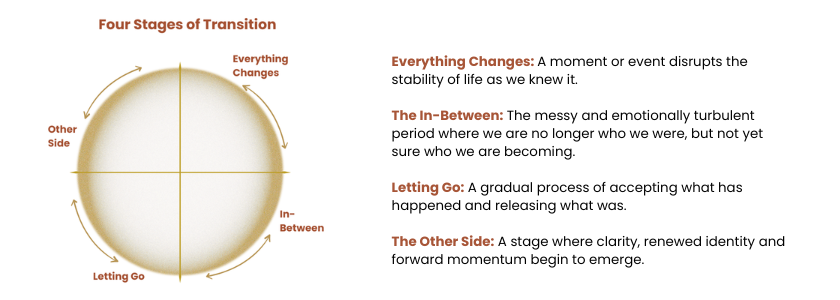
The four stage transition model developed by coaching leader and author Annie Stewart PhD.
Why understanding change matters
Annie’s story reminds us that none of us are alone in the messiness of transition. Even when life appears together on the outside, most women are quietly navigating change.
When we understand what’s really happening, those difficult emotions and overlapping pressures can stop feeling like failure and more like part of the process. From there, we can move through it with more courage, self-compassion, and trust that something new will take shape.
Change is an inevitable part of our Second 50 journey. The important thing is knowing how to meet it with awareness, self-kindness, and support.
We are so grateful to Annie for being an active contributor in Second 50 and sharing her wisdom and story.
Second 50 members can watch Annie’s Sage Advice Live: Growing Through Tough Transitionson-demand. We also developed a S50 Reflection Tool from this session, designed to help you pause, reflect, and make sense of the transition you may be navigating right now, or helping someone you care about to navigate.
In March 2024 Annie led a Sage Advice Live: Career to Calling, which is also in our on-demand library, along with Annie’s e-book and other tools. This session included unpacking what a calling really is (hint: it’s not just about your job) and how to find yours, exploring the essence of what it means to be called, why the transition phase feels so chaotic, and how we can begin to listen to the wisdom of our bodies.
Visit Annie’s website here: https://sympaticocoach.com.au/ or connect with her in our Second 50 ecosystem.
About Annie Stewart
Annie Stewart is the founder and managing director of Sympatico Coaching Practice (est. 2000), where she coaches leaders and emerging leaders to growing through change with impact and confidence. She also offers coaching supervision to corporate and career coaches. With an enduring passion for researching and writing about how to find and follow callings, Annie is the author of several books, including "Career to Calling". Annie’s new book, titled “When Everything Changes: Growing Through Tough Transitions”, will be published in 2026.
Visit Annie's website: https://sympaticocoach.com.au/